
ChartTalk: Inflation is taking a bite out of people’s wallets. But some products are seeing greater price increases than others. The infographic breaks down inflation by a variety of products.
Prices are going up, with some products seeing greater inflation than others.
Food items like beef and essentials such as car maintenance are showing the strongest upward pressure. Service-related costs, including home insurance, healthcare, and utilities, continue to rise faster than most goods.
The infographic breaks down inflation by product type, revealing where Americans are seeing the biggest price changes

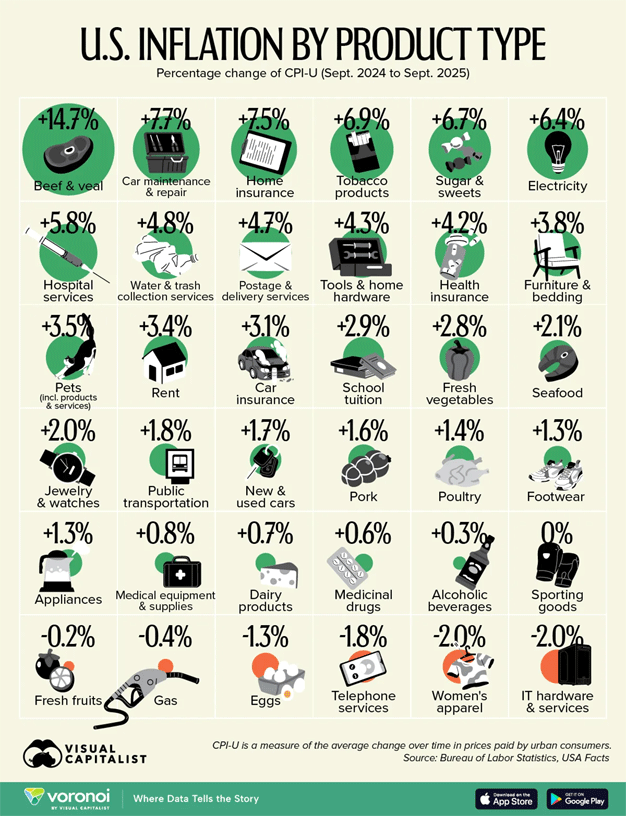
The data come from the Bureau of
Labor Statistics, accessed via USAFacts. The data describe year-over-year inflation rates
from September 2024 to September 2025, based on CPI-U (a measure of the average
change over time in prices paid by urban consumers).
Among the categories shown, beef
and veal prices jumped 14.7%, leading the pack. Food inflation has been a major
pain point in recent years, with a recent survey finding that 90% of American adults
are stressed about the cost of groceries.
While some prices continue to
climb, other categories are seeing declines. IT hardware and services (-2%),
women’s apparel (-2%), and gasoline (-0.4%) have all recorded price decreases
over the past year ending September 2025.
Inflation as a Cornerstone
of Planning
Inflation, however, isn’t just a
short-term annoyance — it’s a long-term financial force that compounds quietly
over time. Even modest annual increases can erode purchasing power, shrink
retirement income, and gradually reshape everyday budgets if they aren’t
intentionally accounted for. Many of the categories experiencing the sharpest
price pressures today — healthcare, insurance, food, and essential services —
also tend to be the same items that play a major role in retirement and
long-range financial planning.
This is why building an inflation
strategy is so critical. Incorporating realistic cost-of-living assumptions,
diversifying income sources, and considering investment options that
historically outpace inflation can make an enormous difference over a decade or
more. The earlier individuals and families plan for persistent inflation, the
more flexibility and resilience they have when prices inevitably shift. In an
environment where certain costs continue rising faster than others, proactive
long-term planning isn’t just helpful — it’s essential for protecting financial
stability and future goals.